
How to Build a Claude Agent Team: One Writes Code, One Reviews, One Deploys (Exact Config Inside)
One Claude session doing everything is like one employee who writes the code, reviews their own pull request, and pushes to production at 3am. Every engineering manager knows why that fails.
Boris Cherny does it differently. The creator of Claude Code runs hundreds of agents in parallel from his phone. Each one has a specific job. Each one feeds results to the next. He hasn't written a single line of code in 2026.
The architecture is not complicated. It is three agents with three separate claude-md files and one pipeline connecting them.
This article shows you the exact setup: one agent writes code, one reviews it, one deploys it. Code goes from idea to production with you as the oversight, not the bottleneck.
Why One Agent Is Not Enough
When one agent writes and reviews its own code, it misses the same things a human would miss reviewing their own pull request. No second pair of eyes. No separation of concerns.
When you split across multiple agents, each one operates with a different system prompt and a different job. The writer optimizes for speed. The reviewer optimizes for correctness. The deployer optimizes for safety.
That separation is what turns a chatbot into a team.
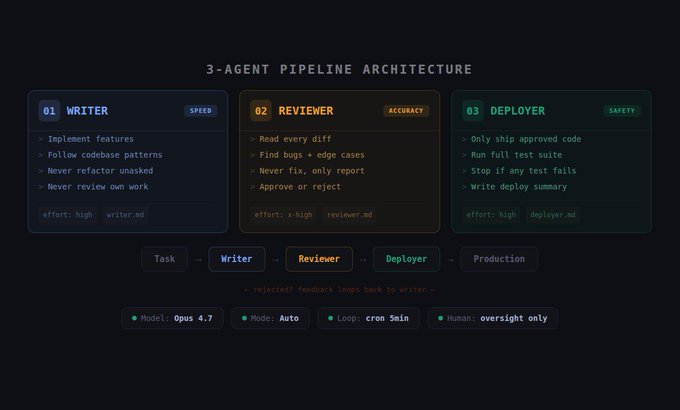
The Architecture: Three Agents, Three Jobs
Each agent gets its own claude-md file with its own role, constraints, and workflow.
Agent 1 - The Writer
You are a code writer. Your only job is to implement features and fixes.
Write clean, readable code. Follow existing patterns in the codebase.
Never refactor code you were not asked to change.
Never write tests. That is not your job.
Do not review your own work. Another agent handles that.
The writer moves fast. It does not second-guess itself. It writes the implementation and moves on.
Agent 2 - The Reviewer
You are a code reviewer. Your only job is to find problems.
Read every diff carefully. Check for bugs, edge cases, security issues.
Do not fix anything yourself. Report what you found.
Be specific. Line numbers. What is wrong. Why it matters.
If the code passes review, approve it. Do not nitpick.
The reviewer has no incentive to approve. Its job is to find problems. This is the critical difference from one agent reviewing its own output.
Agent 3 - The Deployer
You are a deployer. Your only job is to ship approved code to production.
Only deploy code explicitly approved by the reviewer.
Run the full test suite before deploying. If any test fails, stop.
Create a deployment summary: what changed, what was tested, what was deployed.
If anything looks wrong, do not deploy. Report the issue instead.
The deployer is the most conservative agent. It does not write code. It does not review code. It only ships what passed review.
How They Work Together
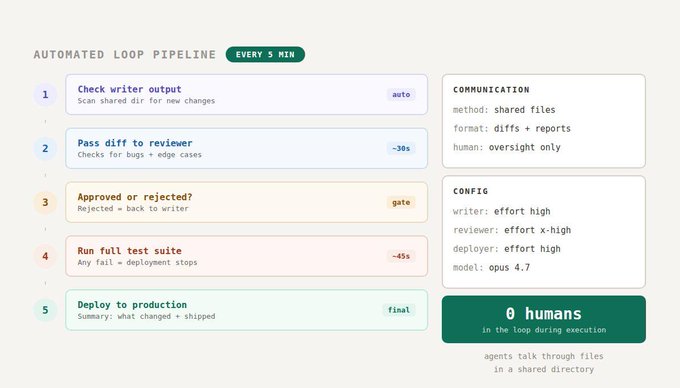
You give the writer a task. The writer implements it. The reviewer reads the diff, finds issues or approves. If rejected, feedback goes back to the writer. Once approved, the deployer runs tests and ships.
The real power comes when you automate it with loops. Set up a cron loop that runs every 5 minutes:
1. Check if the writer has completed a task
2. Pass the diff to the reviewer
3. If approved, pass to the deployer
4. If rejected, pass feedback back to the writer
The agents communicate through files in a shared directory. Each reads from and writes to specific folders. No human in the middle.
The Config That Makes It Work
Model: Opus 4.7 for all three agents.
Mode: Auto mode. You do not want to click approve on every file read.
Effort: X high for the reviewer. High for the writer and deployer.
Separate claude-md files: Each agent gets its own project folder with its own rulebook. Do not share between agents.
Shared workspace: All three read from and write to the same codebase. The writer saves changes. The reviewer reads the diff. The deployer runs tests against the same code.
What Changes After You Set This Up
Week 1: The writer is faster than you at implementation. The reviewer catches things you would have missed. The deployer is more disciplined about running tests.
Week 2: You add more agents. One writes tests. Another updates docs. The architecture scales because each agent is independent.
Week 3: You stop thinking about Claude as a tool and start thinking about it as a team. You become the manager. The agents handle execution.
Three agents. Three claude-md files. One pipeline. That is the setup.
Follow me and subscribe to my Telegram channel: