类库 › kimi-k3-in-c
FareedKhan-dev

FareedKhan-dev/kimi-k3-in-c

这是一个在纯C99环境下运行的Kimi K3大模型推理引擎。无需GPU、BLAS或外部框架,仅用单CPU和8GB内存即可运行2.78万亿参数模型。代码轻量便携,旨在展示极致优化能力,主要面向Linux x86-64平台。

5,779 938 5,779 18
在 GitHub 上查看

截图

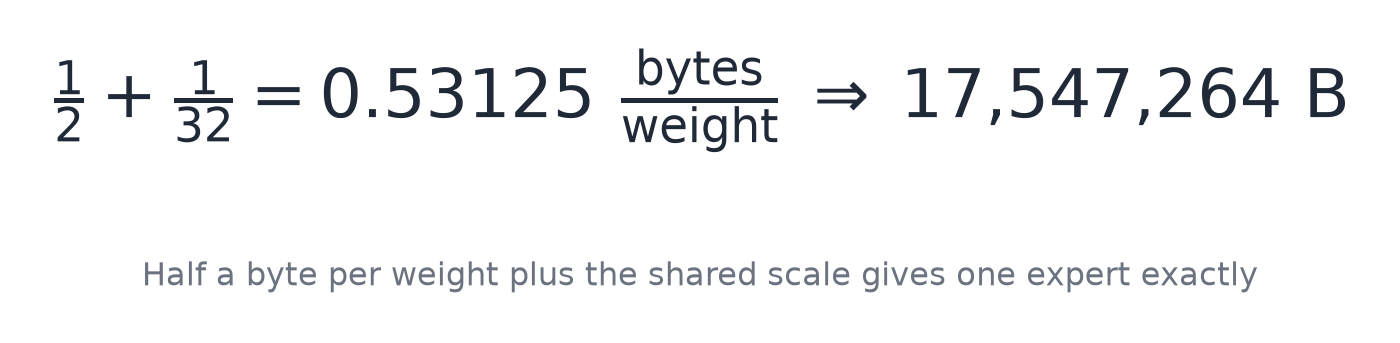
Half a byte per weight plus the shared scale gives one expert exactly
Half a byte per weight saves 4 TB, and never dequantizing saves 194 GB a token
Where one token goes on the floor configuration: 80% of it is waiting on disk
Decay the state, read from it, write the delta, then read the updated state
A depthwise causal convolution of width 4 with the activation fused in
A sum of squares, not a mean, and applied to q and k only
Nine ordered steps, and the numbering is not decoration
Norm first, then gate, then project, and that order is not interchangeable
One latent per position is cached, and k and v are rebuilt on use
Twenty-four MLA layers, expanded k and v in fp32, per position
The released code caches expanded heads, the latent is 53x smaller
Each layer attends over the outputs of every preceding block
Blocks of twelve, so the residual stack never exceeds nine sources
Every twelve layers the running prefix is snapshotted and cleared
Attention residuals drawn by the data: activations climb, then collapse every 12 layers
The bias steers selection only, the weights come from unbiased scores
Route, run 16 experts in a 3584-wide latent, then project back up
Refuse if the bytes are not contiguous, because a gap means copying experts
O_DIRECT needs both ends aligned, which costs 4 KB per layer
Packing 93 contiguous layer runs into one 108.81 GB file
The path one token takes, from cold NVMe to the next word
Pinned layers cost nothing to read, everything else comes through one ring slot
Everything is summed before anything is allocated, then compared to free RAM
One token: embed, walk 93 layers, aggregate, project to the vocabulary
A fixed walk order means the next read can start before this layer finishes
Streaming turns a 315 GB floor into an 11 GB dial
A slot is empty, reserved but not yet readable, or holding an expert
Reserve serially, read in parallel, then publish only what arrived
Batched preads keep the device busy, serial gets leave it idle
The experts this trace touched at all, against a 1.45 TB pool
The rounding budget for 93 layers at hidden size 7168
Op fixtures, a toy oracle, then the released checkpoint
All 93 layers checked against torch: 93 passed, 0 failed, 5639 seconds
Prompt in, 93 layers, one argmax, one word out
Seven memory ceilings, seven different speeds, one identical answer
One prefill wall, then a steady shelf, on every prompt
Prefill scales with the prompt, and nothing after it does
One prefill wall, then a steady shelf, on all four prompts
Prefill scales with the prompt, and nothing after it does
Cap the memory with a cgroup, then check the ids are identical
28x the memory buys 1.70x the speed, and most steps are inside the noise
The memory plan is not lying: every rung lands on its own budget
Token zero pays the pinning cost, so short runs understate the hit rate
The expert cache does nothing at all until about 36 GB of arena
The simulation was wrong in both directions
One counter, three answers, and only one of them means avoided I/O
The only expert-cache metric that agrees with the bytes actually read
What a working expert cache actually looks like, step by step
What one pinned layer removes from the guaranteed traffic
Give the trunk everything until it is pinned, then feed the cache
At a fixed budget, giving the trunk more is 1.69x faster
The winner reads 79% more expert bytes and still wins
Same binary, same prompt, same flags, same machine, same minute
Three identical runs, so a smaller difference is not an effect
Only two timing effects clear the band
The same configuration, measured twice, doing identical work
The same code on two devices, and the gap is the device
Symmetric per-row quantization, the method behind the int8 and int4 study
No layer type tolerates 4 bits any better than the others
int8 costs about 1%, int4 costs about 17%, and its worst rows cost 65%
Seconds are bought back with RAM, and rounding error is not, at any budget
The advertised million-token context is a memory fact, not an engine limit
What this engine does not implement, drawn to scale
From a 1.56 TB checkpoint to the right answer, on one machine
docs/images/patrick_pray.png

评论

inicio - Wiki
Copyright © 2011-2026 iteam. Current version is 2.155.2. UTC+08:00, 2026-08-17 06:19
浙ICP备14020137号-1 $mapa de visitantes$